Sunday, 24 June 2012

The cheque is no longer in the post!

This is it - the cheque that NFU have sent Catherine - the full amount she was owed plus interest from the date they should have paid!

More good news, as well, that Buster's owners have also been paid and NFU confirmed last week that they will cover a new horse who is due to come here at the start of July!

Nice one, Catherine, and well done NFU for finally doing the right thing :-)

Saturday, 23 June 2012

Also available in white...

They've had a lot of rain in Suffolk...especially for the time of year...Debbie sent me this pic of Paddy, taken on his birthday...  :-0
Nicely done, Padster!  Still, he's enjoying himself which is the main thing - its not even a year since he had his colic surgery and its not even 6 months since he went home, so on the whole he should be pretty pleased with himself on his birthday :-)

Many happy returns, Paddy!

Friday, 22 June 2012

Dali - 2 and a half weeks

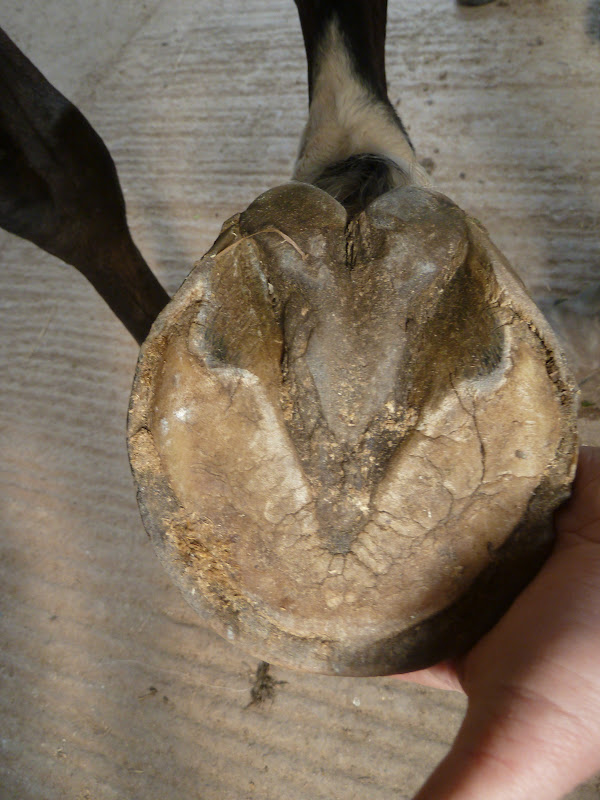
Sorry about the late blog - the internet was down yesterday so I am behind on stuff! I thought Rachael could do with a Dali update - there is not an enormous amount of change yet in his hooves as he has only been here 2 and a half weeks but at least he is starting to head in the right direction!
Looking at the obvious event line, you can see the its already moving down his hoof so even in this short time there is some good growth happening.

Some improvement in the frog and the foot is starting to develop at the back.

This is the sort of thing we need more of, to stop his toe first landing and the stress on his DDFT...


Thursday, 21 June 2012

A year ago it was all about wedges!

Believe it or not, its a year since the arrival of Dillon - who of course came to be known to everyone as Dillon-with-the-wedges!
There is lots more about him on his first day here and you can search the blog for news about his progress during and after rehab but, as Nicky has said before: "Much as I want to shout from the rooftops about how fab he is, I am worried about jinxing him"! I am delighted to say, though, that she sent me an update to celebrate his anniversary.

"Exactly a year ago you took off Dillon's monstrous wedges and he started his barefoot rehab...

I am pleased to report that despite the recent grass and trim related blip [a trimmer misread his hooves,  decided to address some supposed "flare" and made him temporarily less capable on uneven ground...] he is much better. Much as I wanted a glorious sunny ride to take some pics, it was very windy and miserable and Dillon is doing a good impression of a skewbald currently so I decided the photos could wait! 

Today [about a week or so after his trim] he is pretty much back to normal on our stony drive and fine out on the road, even the new gritted bit. Even the YM has ridden him and is telling me not to worry he is fine.

Hopefully we can keep on top of things now and then there won't be a need for me to let anyone else to help him trim his feet. "

Wednesday, 20 June 2012

Potentially VERY exciting...

Lots of you have followed the ups and downs as I've tried (with lots of help from others, especially vets Peter Clegg and Jeremy Hyde) to put together some solid research into the rehab we do here.

Of course, Project Dexter, which records the results from horses with navicular and DDFT-type diagnoses, is ongoing and I will continue to add to that (**we are at 50 horses, by the way - surely that's a milestone, and I reckon there will be a big Project Dexter blog before too long!!!**).

HOWEVER, this is something different - and it has great potential - though I won't know till next week if its really going to work...

To give you a bit of background, there are 2 ways of assessing damage to tendons and ligaments (ie the stuff which won't show up on x-ray) - either ultrasound or MRI.  
MRI is fantastic, incredibly detailed (images above courtesy of Hallmarq) and extremely expensive (it runs at £1000-1800 currently); it can also only be done at specific veterinary centres which have the right facilities.

Ultrasound is much cheaper and is portable - most veterinary practices have ultrasound machines which can be transported in the back of a car. Its often used to scan leg injuries but its much more difficult to get images of damage within the hoof capsule. Although I've heard eminent French vet Prof Jean-Marie Denoix describe obtaining ultround images of the DDFT within the hoof till now I've not come across a vet in England who thought it was do-able.

But step in Anna Ehrle, a fantastic German vet who joined our local practice last year. She's been to Rockley a couple of times and I've been extremely impressed with her but it was only in the last few weeks that I discovered she was a bit of an ultrasound specialist.
When she was last up here I asked her about scanning within the hoof and she was confident that we could get images of the DDFT and navicular bursa and that damage would show up provided it wasn't too deep. I mulled it over and realised that ultrasound would give me a way of looking at DDFT damage before and after rehab, and although it wouldn't be cheap, it would be a hell of a lot more practical than repeat MRIs.

It seemed mad not to give it a try so, after talking to M, Dali and Eva's owners, next week we are taking the plunge and Anna will come up here and scan all 3 horses. The advantage is that we already have MRI for Eva and Dali, which will give us a control for what we are looking for in the DDFT. Even better, Dali and M have been here only a short time, so if the scans are useful we can re-scan them at the end of their rehab.

I'll let you know next week what the scans are showing us, but I have high hopes - keep everything crossed...  :-)

Tuesday, 19 June 2012

M: the one you've been waiting for...!

Finally, a chance to post M's pics - they should have been up last week but with all the excitement of HandH, NFU and the monster grass post, I ran out of room for him...
M is of course our scholarship boy and he arrived 10 days ago from Derbyshire. He is an 8 year old ex racehorse who came out of shoes one by one earlier this year essentially because his feet were no longer able to keep them on. 
To say he has a good range of hoof issues would be an understatement (the uneven hairlines are a good clue that these feet have been unbalanced for a while), but his feet in some ways look better now than they have done in the past. This shot below came with his scholarship application and shows his RH in 2011 following a resection for a severe crack (he also had a crack in his LF).
The lower photo is the same hoof today. The crack has effectively healed with coming out of shoes and stopping the peripheral loading which was over-stressing his hoof wall. Of course his feet have other issues now, not least having weak, collapsed, under-run heels and long toes, so that's what we have to try and improve during his rehab. 
Like many ex-racehorses, M also has thin soles and is very prone to bruising. These sole shots confirm the weakness at the back of his hooves but what you can't see is that his soles are so vulnerable at the moment that they flex on thumb pressure. Often this is due to dietary or metabolic problems, but M has been tested and come back clear, so its possible that they are the result of shoeing or the soles being mechanically thinned in the past in preparation for shoeing.
The dark shadow in these photos is bruising and its this which is going to give us a real balancing act to deal with during rehab. His hooves desperately need work and stimulus to improve but bruising and damage is a real risk. Fortunately the tracks here are a god-send for horses like him, as he can get the stimulus he needs without being on surfaces which are too challenging.   
The only problem is that - as an 8 year old TB - he isn't always convinced that going slowly and quietly is a good idea and he is rather revelling in his new-found social skills so I just hope he doesn't over-do it!
Finally, shots of the back of his foot for completeness. RF, as you can see, has the weaker frog but they are more or less as you'd expect for a horse just out of shoes and certainly aren't as bad as some. 
The heels are higher than the frog but - as with most horses with similar diagnoses to M - its not the heels that need to come down, its the frogs and digital cushion which need to become stronger. His heels also need to move back to be able better to support his limb, but that should come with time, movement and a better hoof capsule.

Monday, 18 June 2012

Bizarre feet of Legend

This week I thought I'd start the blog with some bizarre looking feet. These belong to Legend, who has been here 8 weeks now. He came here because of a long term navicular lameness but had also suffered from mechanical laminitis while in remedial shoes. 
When he arrived here he had very distorted hooves. He had been out of shoes for about 6 weeks but the nail holes are still visible. He'd just started to grow a better connected hoof capsule but it was clear he had massive changes to make. 
Here he is 8 weeks later, with a reasonable amount of new hoof capsule grown in. The problem is, though, that he has a double whammy of issues: weak heels, frogs and digital cushion and related soft tissue injuries (a safe assumption) from the navicular PLUS thin soles, long toes and solar and laminar pain from the laminitis. 
In practice, this means rehab is a slow, difficult process - even more than usual - because while his weak palmar hoof needs movement to strengthen it, the work has to be done in a way that doesn't damage his thin soles. 
However, despite having restrictions as to what we can let him do in the way of exercise, he is making some good changes to his feet. You can see in these photos that his heels are becoming more supportive and - although his toes are shockingly long still in the lateral shots - the foot is becoming more balanced. 
Here is his foot from the front, day one versus today.  The new hoof capsule growth is clear in the lower shot and I hope you can see that the medio-lateral balance is better too. 

There is always a danger in posting photos of really odd-looking hooves. 

I suspect that a lot of you will be thinking that he would be far better off if his feet were trimmed and particularly if the toe was taken back. 

Believe me, I would like nothing better (cosmetically) than to take a pair of nippers and a rasp to these feet and make them look pretty......BUT feet that look prettier in photos on the blog are no good to me or - especially - to Legend or to his owners unless he is also sounder on them and moving more freely. 
Of course, in one way it would help his biomechanics if he had a shorter toe...BUT if you whack off the toe in a trim that will immediately overload the palmar area, not good for a DDFT and collateral ligaments which are already under strain and which are in the early stages of becoming stronger. 
Also, if you look again at the solar view you can see that there really isn't that much which you could trim without being invasive - its not that his white line has stretched, its his whole hoof capsule which distorted with the remedial farriery - so again, although the appearance of the hoof from above tells you to trim, everything else is telling you to leave well alone. 

Legend is doing a great job of changing his feet and improving them as fast as he possibly can, but if we try to accelerate that by "rebalancing" his feet today then all we will do is put the tendons and ligaments within his hoof under even more strain than they are already - and he will be less sound not more sound - though his feet will appear "prettier" and may look less bizarre on the internet - but (for me) that's not a good enough reason to trim!