Tuesday, 18 June 2013

Who remembers "Dillon with the Wedges"?!

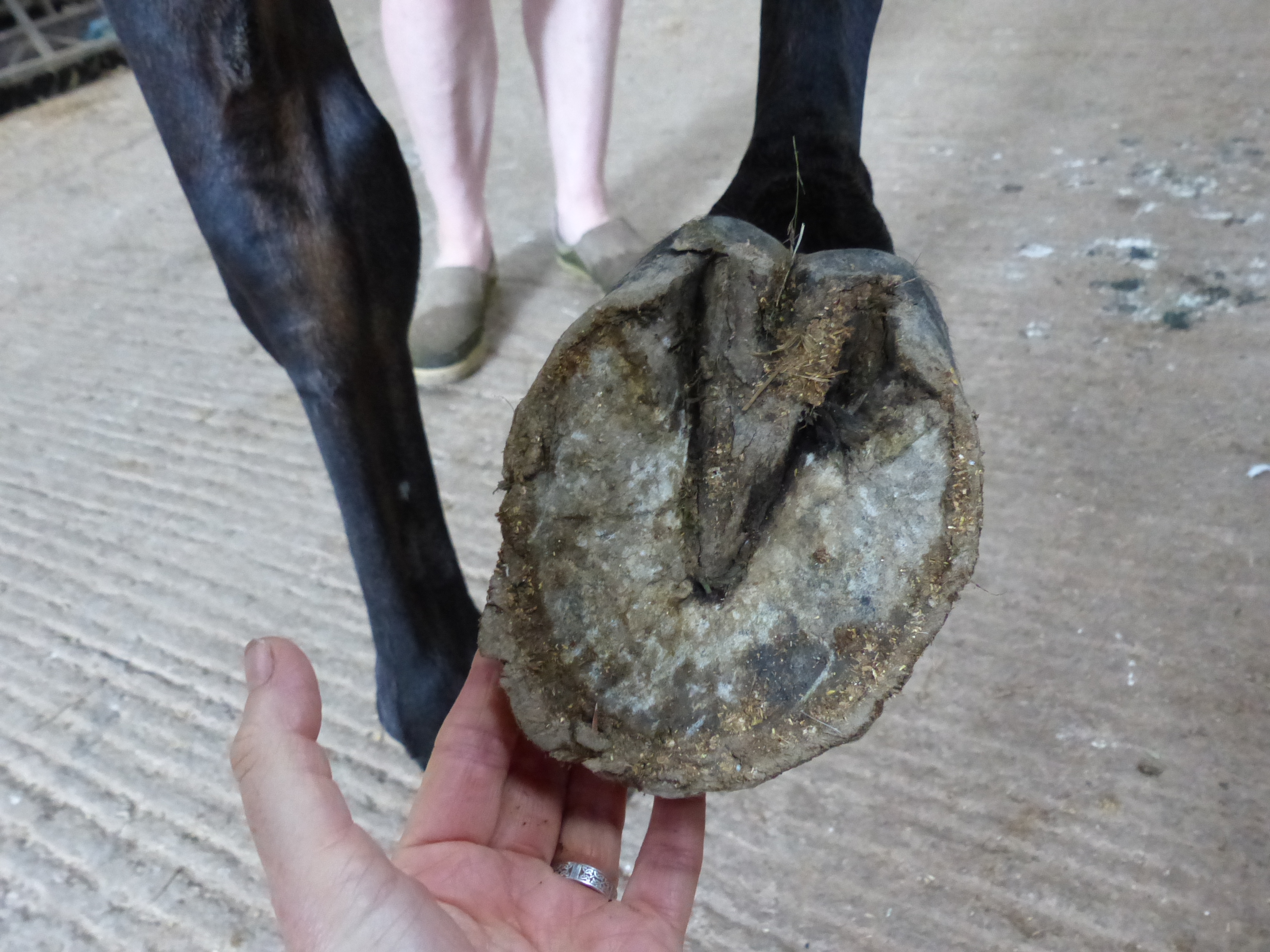
Its hard to know where the time has gone, but 2 years ago a horse called Dillon arrived at Rockley. He had such wacky footwear on that he rapidly was known to all who read the blog as "Dillon with the Wedges".
Not the most elegant soubriquet, but certainly memorable. Dillon had been on box rest but that plus the farriery hadn't improved him. However, over the next few weeks he adjusted well to life without wedges...
...just LOOK how much grass we had 2 years ago...doesn't look like that at the moment, I hate to say...

Anyway, the point of this post is to share a fantastic update which I've had from Nicky, sent on Dillon's 2 year anniversary. 

Dillon has always been a total sweetie but his one foible was crossing water. He HATED it and the more water the more likely he was to make a fuss. So how about this for an anniversary present...!
Nicky and Dillon have recently moved to a new yard and obviously its enabled Dillon to conquer his phobia once and for all! Even better, Nicky has this to say about how he and his feet are doing: 

"Once in he proceeded to try to drink and then splash about soaking us both. So I got back on and took him back in and out from both edges a few times. My new hacking buddies waited so patiently while we did this, even though one had also got her feet soaked helping me. Then we went up a hill akin to Exmoor (aptly named the ‘fitness fields’) and so we had a mooch round a huge field before we came home (back through the water - no problem!)

And do you know through all of this varied terrain he just stomped on!  More updates as we continue to explore, but my god today has been brilliant and extra specially so as its his barefoot anniversary!"

Happy anniversary Dillon and well done Nicky - you both look fantastic and many happy updates to you both :-)

Monday, 17 June 2013

Itsy - 6 week update

Itsy - the mare in a hurry - has now been here for 6 weeks, give or take. Her owner Amanda is down to see her next week so now seems a good time for an update.
This is her worst foot when she arrived. She was lame even in walk but the handy stripe down her foot gives a good indication as to how it is coming back. In this photo the angle of the stripe is acute, her heel is under-run and her toe is long.
Three weeks later there is new growth and the nail holes have grown down. The stripe is at a less acute angle and her palmar hoof is more substantial. 
At six weeks the angle of the stripe is changing again. The nail holes are even further down and she has a much more robust palmar hoof.
The sole shots confirm what we can see on the lateral view. 
The important points on this photo are the heels, bars and frog - then compare them to her feet at 6 weeks, on the photo below.
Although this frog looks tatty, that's just because its shedding. Its actually a much healthier hoof than it was a few weeks ago, as you can see by the fact that the heel buttresses are more even, the heel is less contracted, the frog is beefier and the hoof is much more symmetrical. 
 Proof of the pudding, Itsy's landing has improved - she has gone from a toe first to a slight heel first landing and has a better stride length.
Itsy's footage is here and I expect more improvement over the next few weeks.

Friday, 14 June 2013

Grass, footy horses and ways of managing

Its that time of year again, and after last week's fabulous sunny weather most horse owners are on the watch for foot problems related to grass. 

Of course, many horses can tolerate or even do well on quite a lot of grass but - as always - it depends on the horse AND it depends on the grass. 
A healthy horse who can safely graze on old, permanent pasture may go footy within hours if turned out on heavily fertilised rye-grass. 

And to make matters even more complicated, its not just the type of grass and how its managed that you need to consider. The weather, and even the time of day, can make a difference to sugar levels in grass so that the risk of turning horses out fluctuates considerably. 

One way of monitoring how the risk from climate is affecting your grass is to use the laminitis app. Phil Hunter from Vizar, who developed the app, explains how it works: 

"There has been a lot of discussion on the forums recently about what causes the Laminitis App to show a high risk reading, especially over the past week. Mostly people have been celebrating the arrival of the British summer, enjoying the scorching hot days and long light evenings. For anyone with a horse prone to laminitis, this can be potentially one of the worst times of the year!

Contributing factors over the past week that would result in an increased risk level are: increased daylight hours, clear skies throughout day and night resulting in huge temperature oscillations between day and night. For example some places have seen daytime temperatures in excess of 20ºC and a subsequent fall in temperature down to 4ºC during the early hours of the morning. Whilst this may not be enough to shutdown the grasses' ability to respirate completely, it is still enough to slow things down sufficiently to cause the grass to accumulate NSC. Over the past 2 to 3 weeks there has been an increase in the number of reported cases of horses showing signs of being footy as well as cases of laminitis and colic.

The Laminitis App uses a sophisticated computer model that has been tuned to recognise various weather patterns that have resulted in confirmed laminitis cases. Time and time again whenever a grazing related laminitis case is reported, it can be attributed to a high risk period which had had been predicted by the app. To make this possible weather data from over 300 weather stations located throughout the UK is bought in. This data is updated on an hourly basis and is re-processed using the computer model to provide an up-to-date laminitis risk indicator.

The Laminitis App will default to the nearest weather station to the location you have chosen. If you are monitoring more than one location that are close to one another and have noticed that the risk varies, it is likely that each location is closest to a different weather station.

It is important to note that the app is designed purely as a guide to warn you of weather conditions that you may not have noticed yourself; it should be remembered that green doesn’t necessarily mean ‘safe’ but that the grass is most likely behaving as it does when not under stress – horses vary widely in their ability to tolerate grass therefore owners need to understand and decide for themselves what is ‘safe’ or at risk for their horse."

The app has been very helpful in highlighting the risks to owners and yard managers who were perhaps unaware of how volatile UK grass can be, but its best used as an add-on to a good management programme and your horse is always going to be the ultimate authority on whether the grass is safe for him  - or not!
This is a table which I posted last year, giving a general overview of risk levels with grazing. Generally the more of the red factors which apply, the more vigilant you need to be.

Its important to remember too that its much easier to act at the stage when your horse has become slightly footy than to let the problem develop into - at worst case - full blown laminitis.

Take footiness as a warning sign, especially if your horse has previously been sounder, and act quickly. Restrict grazing - if in doubt take your horse off grass completely - and review your feeding plan to ensure that mineral levels are adequate.
I'll assume anyone reading this blog is already aware of the importance of feeding minerals - something like Progressive Earth's Pro Hoof or Pro Balance - but many horses benefit from additional magnesium oxide and salt at this time of year. Both can safely be given even if you aren't sure whether your horse needs them - and some owners have also reported success with adding sodium bicarbonate to feeds.

Once you have any footiness under control, reintroduce grazing in a controlled manner - for instance using a grazing muzzle, fencing off a track or restricting turn-out to safer times - at night, or using the laminitis app as a guide to when weather factors are less risky.

Thursday, 13 June 2013

Thomas the Third's 3 week update

Thomas the Third has been here 3 weeks so its time for an update. He arrived in shoes with very under-run heels and long toes but otherwise with lots to like about his feet. However he has been intermittently lame for a long time and was last assessed by his vet as being 2/10 lame on a circle. 
The lameness blocked to the palmar hoof so, as always, its this area that we are trying to strengthen and develop with rehab. 
I haven't trimmed Thomas at all but you can see that by taking his shoes off, putting him on the tracks and working him within his comfort levels, his foot as shortened and come back to a much better balance.
The other benefit of the tracks - and being without shoes - is that his frog has been able to develop. This is the foot he was pointing on arrival and he was also landing laterally. 
The effect of that is easier to see now his shoe is off - the lateral side of his foot is clearly larger and has been taking more weight than the medial side. This is something which should start to improve over the next few weeks. 

Wednesday, 12 June 2013

Bouncing boys!

This should bring a mid-week smile to all of our faces :-) Photos from the weekend of two of last year's rehab boys. So we have Buster and Kirsty out jumping...
...and Dom and Georgia at their dressage test. 
Two extremely competent and gutsy young riders with their faithful steeds - well done to you and the teams behind you!

All the more encouraging when you remember that both of these horses were given poor prognoses when they were originally diagnosed but seem in fact to be going from strength to strength (hope I don't jinx them with this post!) and doing more than ever... 

Tuesday, 11 June 2013

Polish pals

By complete coincidence our 2 most recent arrivals both have Polish passports. Meet Mina (on the left) and Aleska (on the right) who have only been here a few days but are already settling in.
Both have a lameness which is worse RF, though Mina's lameness has been a longer-standing problem than Aleska's. 
So, on to the feet...
Aleska's shoes came off at the end of April, when she had her MRI but the nail holes are still visible. What jumps out at me is the uneven hairline at the coronet.  This is usually a sign of uneven loading, which was confirmed on her MRI. 
A pretty good frog but everything is a little bit twisted. She has flat feet and there is lots of separation between the hoof wall and internal structures. Now its just a case of seeing if we can help her grow better feet!
Mina arrived in reverse shoes - "normal" shoes put on back to front, with a graduated pad.  On MRI she had lots going on, with damage to the DDFT and impar ligament and navicular bone changes. 
I'm indebted to vet Chris Tufnell of Coach House Equine for the photos of Mina which he sent down before she arrived (I should add that the shoes were not his prescription!). This is the RF and - rather like Aleska  - the deviations in the hairline give a pretty good indication that her medio-lateral balance is wrong and putting stress on her limb. 
More on both of them soon, and in the meantime I am hoping Wiola will give me some key phrases in Polish (in addition to Bez Kopyt nie ma Konia, of course, which was the title she devised for the Polish edition of  "Feet First") to make the girls feel at home. Although, like Wiola, their English is probably way better than mine!

Monday, 10 June 2013

Good news - you've done it again!

Well, thanks to all of you who sent good vibes Wally's way because the shockwave treatment seems to have done its job! He still has one treatment to go but I was so impressed when I put him on the lunge on Friday that I decided to see how he felt under saddle. 
And look - proper step under with his LH - clever boy - as well as a nice stretch out in front. 
I am absolutely delighted for Wally and for his owner, Ruth and huge thanks are also due to our fab vets Anna Ehrle and Gordon Sidlow who diagnosed his LH suspensory injury and have treated it so successfully. 
But back to the front legs - Wally's original problem - and here is a quick recap of how his feet have changed over just under 4 months. 
Look how much the palmar hoof has improved and how much more supportive the heels and digital cushion have become. 
You can see that once the new hoof capsule has completely grown in, he will have a much shorter toe and his hoof will be in a much better position to take the load from the limb above. Clever Wally!