Wednesday, 12 September 2012

Rolie and the bar shoes

Our latest arrival is Rolie, a big Irish sports horse who has come all the way from Yorkshire. 
He was diagnosed on MRI with collateral ligament damage to his LF in 2010 and more recently had an MRI in June which showed navicular bone damage, coffin bone arthritis, impar ligament damage and old collateral ligament damage. 
His lameness has been caught at a relatively early stage and so I am hoping that we will be able to see some quick changes with him. Its interesting looking at his RF on the day he arrived...
...and compare it today (thats only 48 hours difference). What has happened very quickly is that the long, weak hoof wall has chipped away. 

I am always amazed when farriers or trimmers suggest its a good idea to "leave the hoof wall a bit longer" - they may think its a good idea but horses definitely don't agree. Rolie hasn't been trimmed, of course, and all he has done is meander around on the tracks and in the field but even so that long hoof wall is too weak to support him and its rapidly disappearing. 
He was due for shoeing (as I always prefer horses to have had shoes on for 4-6 weeks before they are taken off) but there are clearly issues with this (his worse) foot as the hoof capsule and the shoe are migrating in different directions. 
Even at this early stage its fascinating to see how hooves react to coming out of shoes.
Think about how hooves load. Here is Rolie's hoof in his bar shoe and its pretty clear what connects with the ground. The load is taken entirely on the bar shoe.
Out of the shoe the hoof capsule is still shaped by it (the change in colour is only because he had been lunged in the sand school!)
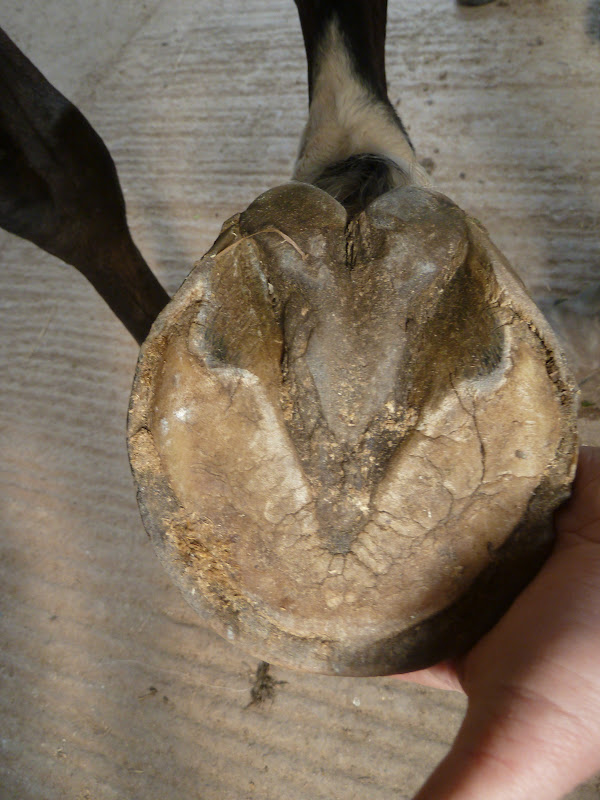
This is the same foot today - only 2 days after his shoes came off. There are lots of interesting things about this photo but the key factors are the change in the frog and the fact that the dead sole and long hoof wall have simply abraded away. He hasn't been trimmed at all but already his frog is responding to being asked to work. More on Rolie soon!

Tuesday, 11 September 2012

It really can work!

I received an email yesterday that is still making me smile and I am going to post it here for anyone who is in the same boat. The sender is far too modest and glosses over her own (I have no doubt) extensive hard work, research and (if she is anything like the rest of us) sleepless nights but what she says is spot on:
"Dear Nic
I emailed you a few months ago requesting some advice for getting a good trimmer as I (now embarrassingly) said that I understood that trimming was the most important part of going barefoot.

You could have been forgiven in telling me what a twit I was and that I was missing the point in regards to what is vital for successful transition .. however you were very tactful and pointed out that trimming was the least of my worries and pointed me in the direction of diet and exercise planning.

I realised my mistake and promptly researched barefoot more thoroughly on your blog and bought your book which I have now read three times...

I am 4mths into barefoot ... my horse was actually immediately amazing on all surfaces but grew very strange feet shapes for about 2mths but now they look amazing and she has a frog and digital cushion to die for

My daughters pony had a slightly harder time but I worked hard in regards to feed and careful excercise and now she is also fantastic but I cannot take liberties with her as perhaps is possible with my horse... she has also grown front feet that look from the front pidgeon toed if you will but she has never moved so well so it clearly is the shape she needs

Thank you for your tact which spurred me on and your wonderful book as a reference manual and your blogs which just continue to encourage.

Many thanks Em
ps neither has seen a trimmer once..."

Monday, 10 September 2012

Barefoot on the rocks

I had a lot of fun taking photos of Bryan over the weekend...
...and while I had the chance to get my sticky little fingers on a super-duper camera I couldn't resist trying to get some close up photos of bare hooves going over stony terrain...
If you look closely at these pics you can see the flints flying as they are kicked up by his front feet...
...(there are at least 4 flying flints in this photo!)...

...and here comes Dexter (yup, his hoof capsule is still bizarre)...
Bailey...

...and Charlie...


Sunday, 9 September 2012

A grand day out with Big Barefoot Bryan

I had a lovely day yesterday with former rehab Bryan and Charlotte at Hickstead. Bryan is still getting used to jumping on grass without studs but he is on great form and is looking a million dollars.
He has put on lots of muscle and is looking incredibly well and is clearly enjoying being back jumping again. 
In fact, Bryan actually moved better and looked sounder than the majority of horses I saw there and it was great to see what a happy partnership he and Charlotte are. 
I was also fortunate to have been loaned for the day a super-duper Nikon camera with an incredible lens, hence the better than normal photos :-) Thanks to Ted for the loan but now I am completely spoilt, of course!
Its days like this that rehab is all about!


Friday, 7 September 2012

Fast changes - dynamic hooves over a month

There are always discussions going on over the internet about trimming, hooves and how to improve soundness, performance and hoof quality. That's great - only a few years ago barefoot horses were a rarity and working horses barefoot was viewed as bizarre but now they are everywhere. 

Although more people now "get" that horses can work effectively and perform in all sorts of disciplines without shoes its still commonplace for owners and professionals to think that improving hooves is all about trimming. 
As you regular readers know, I've found that trimming is one of the least important aspects of hoofcare and the rehab horses here confirm that all the time. Here is the latest example - Eliza, who has been here just over a month.  She is 17 years old and has been shod for all her working life, as far as we know, but boy is she keen to grow better feet!
She had her shoes taken off a few days before she arrived (you can see the nail-holes and long chipped hoof wall in the top photo) but she hasn't been trimmed. 
As you can see, her hooves were quite weak. Contracted, under-run heels, weak frog (and of course a toe first landing), stretched white line and a big ridge of sole which extended from her bars and was trying to compensate for her medio-lateral imbalance.

One option would have been to trim all the long wall, whack off the bars and sole ridge and immediately "tidy" the hoof up. 
Guess what? That would have removed what little structure she still had and would have made a drastic, shocking change to her hoof balance before her soft tissue  was able to cope. The back of her foot would have been overloaded while still weak and she would most likely have been a lot lamer.

By giving her time, correct work and better surfaces - lo and behold everything starts to strengthen and come back into better balance. Now the foot is strong enough to start to load heel first and she can start to repair the damage.
Caudal shots confirm that the frog is beginning to improve though it has a long way to go. As is often the case, its not the heels which are too high and need trimming but the frog which is weedy and needs to beef up. Another reason not to trim.
From this angle you can also see that the foot is starting to be less pinched and to have a broader base of support. If you look at the angle of the hoof wall its beginning to straighten rather than contract.
Same story on her worse (RF) foot. From this angle its clear how her foot was losing its base of support and not only under-running but also narrowing.
Feet are desperate to support the limb - we just need to give them the chance. 

Thursday, 6 September 2012

M is for...

"mad hooves", quite possibly. These of course are M's hooves. He has now been here 12 weeks so its time for another update. 
To recap, he arrived with all sorts of issues, including flat feet, long toes, under-run heels and a history of long term lameness which blocked to the palmar hoof. In addition he threw into the mix assorted hind limb problems - there are more details here.
Today he has a selection of new hoof growth angles - from the worst old growth at the bottom to the new hoof capsule at the top. He still has lots to do, notably improving his palmar hoof strength, but he is doing a good job of growing a stronger hoof and importantly has massively improve his terribly thin soles - to the point where they no longer bounce on thumb pressure(!).
His flat feet will develop more concavity but that won't come till the new growth has reached teh ground and meanwhile you can still see the old damage. The bars are better though and the heels slowly moving back to be more supportive.
From the front when he arrived you could already see that there would be a difference between the old hoof capsule and how the new growth would come in.
Its only today though that you can see how much difference that will make - both to his dorso-palmar and medio-lateral balance. I've taken this picture from a slightly higher angle to make it easier to see the changes in medio-lateral balance. 


Wednesday, 5 September 2012

"The impossible we do at once, miracles take a little longer"

Do you remember this saying, which used to be posted up in many different workplaces? It seems an appropriate motto for rehab especially when you are a "last chance saloon" for many horses but we have to at the same time be very, very realistic and we certainly can't promise miracles.

Take Dali for example. This was his typical stance when he arrived. He had extensive DDFT and impar and collateral ligament damage along with navicular and P3 bone changes diagnosed on MRI in early 2011 but he had been lame for many months before that.
His problems were bilateral (in both feet) although the RF was worse. The prognosis was that he would gradually worsen as his condition degenerated and sure enough by the time he arrived here - in June 2012 - he was extremely lame RF and pointing continually.
His vet had said Dali would not cope barefoot because of his flat feet but equally remedial farriery had not improved him. This is his stance today - better, and happier to load his RF.
For comparison, here are his lateral shots from June (above) and today (below). Big changes in toe length and quite a significant amount of hoof growth (compare the level of the event line) but this isn't the whole story.
From the front its easier to see how his medio-lateral balance is changing. Again, the time difference is 3 months, from June to September.
Its subtle, but look at the hairline in both photos and assess which is more even, which is the better loading hoof, which appears more stable?
The sole shots give, as usual, a good indication of whether the heels are less under-run and whether the palmar hoof is stronger. This is also the place to look for symmetry (NOT from the top!) because symmetry here confirms that the hoof is loading evenly and that the medio-lateral balance is correct. 
A much healthier foot, I am sure you will agree, although the heels still need to improve a lot. Concavity will come once the whole hoof capsule has grown in at the new angle. Incidentally, this is a good example of why frogs shouldn't be trimmed(!) - many well meaning farriers and trimmers would take a knife to this and make it a nice neat triangle...
But while Dali is growing a healthier hoof capsule in a relatively short time this is only part of the picture. He has been lame for a long, long time. On MRI and on ultrasound he has extensive bone damage and bone - while capable of remodelling - takes many months to repair.

Dali is becoming sounder - he is capable of work and is improving but his rehab is not something that can be completed in a few weeks. We have started the process here but it needs to carry on for months and months after he has gone home. Rehab is done in many small, gradual steps over a long period, not in a quick wave of the magic wand and if a horse has suffered severe long term damage then the legacy of that may always impair his performance to some extent.
It can sometimes seem incredible how well horses can recover from long term lameness - but at the same time it is essential to be understand that the worse the damage, and the longer the horse has been lame the longer and more difficult the rehab process will be. Its important to realise that miracles don't always happen - and when they do, it takes a lot longer than 12 weeks for them to be complete.